Mývatn offers a unique natural environment. With large contrasts and small distances you can experience the most and the best that Iceland has to offer. Large open spaces with roads and walkways lead travellers to interesting locations, were volcanic eruptions have played a crucial role in the formation of the landscape.
Whether the plan is to enjoy the landscape, examine unique natural phenomena or take a closer look at the plant and bird life, Mývatn has it all. Furthermore the area offers a variety of services in accommodation, food and entertainment, based on years of experience and knowledge. A large number of travellers visit Mývatn in the summer, but many believe the lake and its surroundings to be no less impressive in the wintertime.
The lake was created by a large basaltic lava eruption 2300 years ago, and the surrounding landscape is dominated by volcanic landforms, including lava pillars and rootless vents (pseudocraters). The effluent river Laxá is known for its rich fishing for Brown Trout and Atlantic Salmon. The name of the lake (Icelandic mý ("midge") and vatn ("lake"); the lake of midges) comes from the huge numbers of flies (midges) to be found there in the summer.
Must do-
Drive or cycle around Lake Mývatn, one of the largest lakes in Iceland, 37km2. Varied bird life, unique nature with landscape being formed by intense volcanic activity. Possible to rent a bike.
-
Climb up to the crater Hverfjall. Walk the whole circle around the rim of this beautiful tephra ring which is one of the largest in the world.
-
Taste the traditional “Hverabrauð” with smoked trout. This is dark bread that the locals bake underground in the geothermal heat. Available at most cafe’s and restaurants.
-
Take a relaxing bath in the Mývatn Naturebaths and don ́t forget to try out the natural steam bath as well, but steam bathing is an old tradition in the area. The spa is open all year round. Spoil yourself!
Summertime (1. June - 31. August): 09:00 – 24:00
Entry no later than 23:30.
Wintertime (1. September - 31. May): 12:00 – 22:00
Entry no later than 21:30.
More information:
http://www.jardbodin.is/en/-
Go birdwatching around the lake and visit Sigurgeir ́s Bird Museum for an interesting showcase and great information on icelandic birds and their habits.
-
Take a sightseeing flight from the local airport in Reykjahlíð village. It sure looks different from above, great views over the region.
-
Rent a bike and cycle to the Höfði Peninsula. Great view to the lake, rich birdlife, trees and vegetation.There is a hiking path around the peninsula and great view from the top of the hill.
-
Get lost in Dimmuborgir lava formations. Great place for hiking, with marked trails that take you around these beautiful natural formations. Beware of the trolls and elves around.
The Dimmuborgir area consist of a massive, collapsed lava tube formed by a lava lake flowing in from a large eruption in the Þrengslaborgir and Lúdentsborgir crater row to the East, about 2300 years ago.
At Dimmuborgir, the lava pooled over a small lake. As the lava flowed across the wet sod, the water of the marsh started to boil, the vapour rising through the lava forming lava pillars from drainpipe size up to several meters in diameter. As the lava continued flowing towards lower ground in the Mývatn area, the top crust collapsed, but the hollow pillars of solidified lava remained. The lava lake must have been at least 10 meters deep, as estimated by the tallest structures still standing.
The lava flow surface remains partly intact around the Dimmuborgir area, so that the Dimmuborgir itself sits below the surrounding surface area. The area is characterised by large hollow cell- or chamber-like structures formed around bubbles of vapour, and some dramatically standing lava pillars. Several of the chambers and pillar bases are large enough to house humans, giving rise to the term "castles" (borgir).
-
Explore the pseudocraters at Skútustaðir, interesting crater formations formed in steam explosions when molten lava flowed over wetland.
-
Visit the geothermal area Hverir by Námaskarð. High temperature area where you find steaming fumaroles and bubbling mudpools. Watch out it ́s boiling hot!
-
Get to know the icelandic horse and it ́s good temper by taking a riding tour through the beautiful district of Lake Myvatn. No riding experience needed.
-
Visit the Krafla area, one of Iceland ́s most active volcanic area. Marked hiking trail to Leirhnjúkur, where the lava is still steaming hot since last eruption in 1984.
-
Hike the marked trail to the top of Mt. Vindbelgur. Amazing view over the lake, pseudocraters and the Mývatn region from the top.
-
Take a day tour to the Askja Caldera and the nature reserve Herðubreiðarlindir. Scenes of unforgettable Icelandic nature and geology. Only accessible by 4x4.
-
Experience the Aurora Borealis - Northern lights, during winter time. You can also go on a snowmobile tour or nordic skiing tour on the frozen Lake Mývatn.
-
Meet the Icelandic Yule Lads in Dimmuborgir during the month of December. These are the 13 “santa clauses” of Iceland, funny and interesting fellows.
-
Dettifoss is a waterfall in Vatnajökull National Park in Northeast Iceland, and is reputed to be the most powerful waterfall in Europe. It is situated on the Jökulsá á Fjöllum river, which flows from the Vatnajökull glacier and collects water from a large area in Northeast Iceland. The falls are 100 metres (330 ft) wide and have a drop of 45 metres (150 ft) down to the Jökulsárgljúfur canyon. It is the largest waterfall in Europe in terms of volume discharge, having an average water flow of 193 m3/s.
-
Buy a traditional Icelandic woolen sweater, as a souvenir to take home. Knitted by the local ladies.
-
Participate in the Myvatn Marathon held in May every year. One of the best views one can get while running a marathon. The track goes around the lake.
-
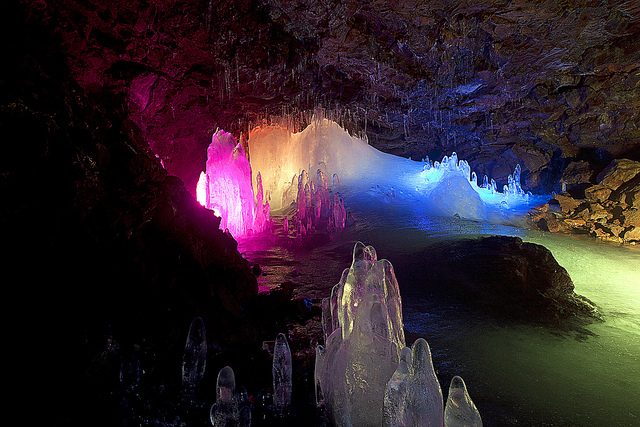
Explore the beautiful cave Lofthellir, a weird world of ice and darkness. Amazing ice sculptures inside the lava cave. Only accessible on a
guided tour and 4x4.
LINKS
Mývatn panoramic virtual tourhttp://www.icelandvirtualtour.com/myvatn-skutustadir-pseudocraters.htmlHIKING FROM DETTIFOSS TO MÝVATN
Many hikers go from Dettifoss to Mývatn (Krafla). This route is not marked and not within Vatnajökull National Park. However, for the many hikers that go this route, here are some points to consider.
Dettifoss – Lake Eilífsvötn (west side) 12-14 km
Eilífsvötn - Krafla ~12 km
Krafla - Reykjahlíð ~13 km
Navigation
The route from Dettifoss to Krafla is not marked and there is no clear path to follow. The hike from Krafla to Reykjahlíð is a marked trail and starts at the car park at Leirhnjúkur. Therefore, during most of the Dettifoss-Mývatn route, hikers need to have good navigation skills.
Hikers need to know how to use a GPS instrument and/or a compass and have a good understanding of maps. There are hills and mountains in the landscape that are helpful for navigation, eg. the mountain Eilífur, which can be easily seen from nearby Dettifoss on a clear day. However, on a foggy day the forms of the landscape cannot be seen and it is easy to lose direction. Those who do not have good navigational skills are recommended not to go this route.
Route landscape
There are no special dangers on the route. The route from Dettifoss to Lake Eilífsvötn goes over a gravel plain, moor and tussocks and is quite easy to pass. From Lake Eilífsvötn, the conditions of the hiking route depends on which direction is chosen. The more west hikers go the more lava and ravines they pass, where special care has to be taken.
Drinking water
Hikers need to carry all beverages for each day of the hike, as there are only three places where there is access to drinking water:
-On the campsite at Dettifoss there is drinking water in containers. Rangers from Vatnajökull National Park fill the containers with fresh water every day. Please use this water as spaerly as possible. -At Lake Eilífsvötn, both on the west side and east side, are springs and brooks which are safe to drink from.
-At the toilet house at Krafla/Leirhnjúku
Berglind Rós, Iceland24h.blogspot.com© 2014 Iceland24h.blogspot.com, December 2014