Thursday, May 29, 2014

Where Do Icelanders Come From?

How long has Iceland been inhabited? Who are the natives? Where do the Icelanders come from?


Settlement in Iceland 

Historians agree that Icelandic settlement began in 874 when a Norwegian Viking called Ingólfur Arnarsson was the first one to settle in the country. He landed in a bay where he saw steam rising from the earth, which he mistook for smoke. He named this place 'Bay of Smoke' or in Icelandic 'Reykjavík'. It wasn't until almost a millennium later that this location became a city (in 1786) and later the capital of Iceland.


The Icelandic Age of Settlement is considered to have taken place between 874 and 930 when the parliament, Althing, was founded in Thingvellir. Þingvellir forms a part of the Golden Circle, a popular tourist route, if you are interested in the Icelandic history you can also combine a tour of the Golden Circle with the Saga trail.


Recent excavations in Reykjavík revealed ruins that date from 871 (+/- 2 years) and there is some mention of Norse Vikings encountering Gaelic monks living in Iceland in the settlement years. Still today, it is possible to read about the Vikings in the Icelandic Sagas.


Icelandic Ancestry 

In fact, Icelanders have about 60% Norse origins and the rest is Scottish or Irish heritage. This is because the Vikings would stop on their way to Iceland in Scotland and Ireland and take people hostage and transfer them to Iceland to use as slaves.


Obviously with time, some 'merge' took place. This explains the fair complexion of Icelanders, with the majority of them having blonde or slightly ginger hair and blue eyes. Some people joke that this explains why the Icelandic men are strong and the women are beautiful, through the strong 'survival of the fittest' Viking genes and the beauty from Gaelic belles.


Icelandic Independence

Iceland was ruled by Denmark, then Norway and again Denmark for centuries and didn't gain it's independence until 1944. Iceland's independence day was chosen to be the 17th of June, the birthday of Jón Sigurðsson, the leader of the independence movement in the 19th century, even though he died in 1879.


Interestingly, Jón is often called 'Jón president' and some people mistake him for being Iceland's first president. That is obviously not true since he died years before Iceland gained independence but this is because he was a president of an Icelandic Literature Society in Copenhagen and also a president at Althing several times. You can see Jón's picture on the Icelandic 500 ISK note or look at the statue of him at Austurvöllur.


Modern Day 

Iceland Today, around 320 thousand people live in Iceland. Only about 30 thousand are immigrants - from various different countries. Native Icelanders can still trace their origins hundreds of years back, simply by looking it up in the National Registry online.

Source: Guide to Iceland
May 2014
Iceland24h.blogspot.com

Friday, April 25, 2014

Travel Safety Info to Appear on Screens Around Iceland

Thirty screens with travel safety information will be set up at the main tourist spots around Iceland. The monitors are part of a new information system run by the Safe Travel project.


The screens will be installed at large information centers, transportation centers, airports, large hotels and gas stations. Preparation for the project involved extensive consultation with the Icelandic Met Office, the Civil Protection Agency, the tourism industry and the Icelandic Road Administration.

Providing information to visitors is an important tool in accident prevention, particularly in a country where weather conditions can change rapidly.


The screens will include warnings, weather forecasts, travel tips, the 112 national emergency number and road conditions via webcam.

Johanna, Iceland24h.blogspot.com
Source: Ferdamalastofa

Sunday, April 6, 2014

The islands of Iceland

Iceland has surprisingly few islands big enough to explore and/or live on. This probably has something to do with how the country was made. The islands we do have, however, add a little bit of extra adventure to any exciting holiday in Iceland.


Iceland’s neighbours across the sea in places like Scotland and Norway seem to be absolutely awash with islands; but then they are physically older landmasses where erosion has been busily breaking up the rocks and currents have consistently been piling up sand and silt into monumental mounds – many of which are now islands.

Iceland, on the other hand, is a volcanic land still being created from a seam between tectonic plates as they move apart. As the lava bubbles up to fill the gaps, we are left with a remarkably circular shaped country, compared to most. As well as this, the forces of nature have not had a very long time to work on island building so far.


Iceland can boast about 30 so-called ‘big islands’ ranging from 13.4 sq. km down to 20 sq. m. We have thousands of rocks and skerries as well, but they are classified as ‘small islands’ and not therefore counted.

Of Iceland’s 30 main islands, nine are of particular interest and can be visited, or viewed from offshore. That number is ten, if you include the island of Iceland itself…Here they are:

1. Heimaey

This is the only one of South Iceland’s Westman Islands (Vestmannaeyjar) which is inhabited by humans. Actually the island has one of Iceland’s bigger towns on it and is worth visiting just for that. But Heimaey is famous for two things above all else: puffins and the big scary 1973 volcanic eruption. The former nest on the island in numbers not seen anywhere else on the planet and the latter kept the islanders away from home for nearly seven months and destroyed a lot of houses. Now you can explore some of those houses, Pompeii style.


2. Hrísey

This delightful, peaceful little island is full of history and has been permanently inhabited since the settlement of Iceland. It is the second biggest island off the mainland and only 15 minutes’ ferry ride from the mainland. The island is today part of the Akureyri municipality and its 170 inhabitants are mostly famous for the seafood they create – especially the beautiful mussels.


3. Grímsey

A fair way further offshore out to the north lies Grímsey – famous mostly for being the only part of Iceland to cross the Arctic Circle*. It’s one of those little human landmarks that we like to go to. See the line. Jump over the line. Jump back again. Take a photo straddling the line. You know how it goes. Fishing and tourism are the 90 inhabitants’ main livelihood.


4. Viðey

Viðey is less than five minutes by boat from Reykjavík. It has a lovely cliffy beach to explore, a small adventure playground, a café and the renowned Lennon Ono Imagine Peace Tower, which is very much worth seeing, even when the lights are turned off.


5. Surtsey

Surtsey is another one of the Westman Islands. Although it wasn’t before 1963. The volcanic eruption that created the island lasted until 1967 and Surtsey has been a natural laboratory ever since, allowing scientists to study how life colonises new land. As a result, you can’t go there. Sorry. But you can get close to it on a boat.


6. Flatey

Flatey in Breðafjörður is the quintessential image of rural Icelandic charm. The green agricultural island has a winter population of just five people, but many more in the summer. The ramshackle, but welcoming village was the set for the Icelandic comedy film Brúðgumminn. The ferry between Snæfellsnes and the Westfjords stops at Flatey and it makes a great overnight stopover.


7. Vigur

Vigur island is one of the Westfjords town of Ísafjörður’s biggest attractions. The island is not in the town, but the ferry departs from there… Vigur is famous for the quality of the farmer’s cakes and waffles, for having the smallest post office in Europe, and for its eider ducks, which are quite unafraid of people and provide some of the world’s most valuable and sought after eider down.


8. Kolbeinsey

This is one you almost certainly can’t visit. It is a tiny rock way above the Arctic Circle famous for nothing more than being Iceland’s northernmost point. In the name of frontier building and political shenanigans, Iceland built a helipad on the rock – which is almost the same size as the whole island. By regularly landing Coastguard helicopters on the island, Iceland proves its sovereignty of the island. At least that was the idea before the helipad crumbled into the sea. The whole island may not be far behind it.


9. Lundey

Lundey is another one just off the coast of Reykjavík, and another one you unfortunately can’t go and walk on. But if you take a whale watching tour, there is a very big chance you’ll stop very close to the island to observe all the nesting puffins from a safe distance. The island’s name means Puffin Island – and that’s precisely what most tour guides call it.


Source: Wow Magazine
Iceland24h.blogspot.com, April 2014

Wednesday, March 19, 2014

Moustache March in Iceland

For the third year running, men in Iceland are encouraged to grow moustaches this March to raise awareness for the Icelandic Cancer Society.

If you visit Iceland in March don’t be alarmed by all the rugged male handsomeness and the incredible number of moustaches going around.


Icelanders grow their moustaches in March for a good causeIn most countries, November is a time for growing your moustache for a good cause. Icelanders, always trying to do things a little differently, use March for their moustache growing. Because this is such a small island this trend really catches on so the number of moustaches becomes monumental during this time.


Some grow it just to fit in but others to compete, either solo or in teams, and raise funds for cancer research. Overall, this fun event encourages men of all ages to talk about the dangers of cancer with each other and get checked out.


Ragnheiður Haraldsdóttir, director of the Icelandic Cancer Society, told RÚV that their goal is to raise 35 million ISK this month. Men are encouraged to grow moustaches this month to show their support for the drive - the more visible moustaches, the more visible support, which then hopefully leads to more donations.

She says that the goal of raising about one million crowns per day might seem high, but the Icelandic Cancer Society intends to make a large promotional effort for the drive, a great deal of it happening on the internet. Moustache March is a crucial part of that drive.


Ragnheiður points out that many people try to raise money by making their own products for sale, whatever they may be. The important thing about the event is to make it fun, from beginning to end.


If you are a male in Iceland of moustache-growing capacity, you are hereby encouraged to leave your upper lip alone this month.

Berglind Rós, Iceland24h.blogspot.com
March 2014

Wednesday, March 5, 2014

Jökulsárlón glacier lagoon in Iceland. An adventure you'll never forget!

Jökulsárlón is today one of Iceland's best known and most popular natural wonders, and for a good reason. A magnificent view welcomes you as you arrive there and it's almost like stepping into a fairy tale landscape.

Jökulsárlón (literally "glacial river lagoon") is a large glacial lagoon in southeast Iceland, on the borders of Vatnajökull National Park. Situated at the head of Breiðamerkurjökull, it evolved into a lagoon after the glacier started receding from the edge of the Atlantic Ocean.


The lake has grown since then at varying rates because of melting of the Icelandic glaciers. The lagoon now stands 1.5 kilometres away from the ocean's edge and covers an area of about 18 km2. It recently became the deepest lake in Iceland at over 248 metres depth as glacial retreat extended its boundaries.


The size of the lagoon has increased fourfold since the 1970s. It is considered as one of the natural wonders of Iceland. The lagoon can be seen along Route 1 between Höfn and Skaftafell. It presents a picturesque parade termed as “A ghostly procession of luminous blue ice-bergs through the 17 km2 Jokulsarlon Lagoon”. Jökulsárlón has been a setting for four Hollywood movies - A View to a Kill, Die Another Day, Tomb Raider and Batman Begins - A postage stamp depicting Jökulsárlón was issued in 1991 with a face value of 26 krónur.


The tongue of the Breiðamerkurjökull glacier is a major attraction for tourists. Tour operators conduct snowmobiles and jeep tours to visit the glacier along the winding iceberg studded Jökulsárlón Lagoon. The base station for visits to the area is at Joklasel, which is approached from Höfn. It is termed as Tourist Conveyor belt.


FAUNA

The lagoon is filled with fishes that drift in from the sea along with the tides. Seals gather in large numbers at the mouth of the lagoon to catch fish during the winter, which is a sight to watch. Large numbers of sea birds, particularly arctic terns, which nest nearby also gather to catch herring, trout, salmon and other fishes and krill.


LANDSCAPE

The white cap of Breiðamerkurjökull glacier dominates the lagoon and its icebergs. Jökulsárlón is separated from the sea by only a short distance, and the combined action of the glacier, the river that empties from the lake, and the ocean may eventually transform it into an inlet of the sea. There are plans to prevent this from happening, since the only road in the area passes over the narrow isthmus.


HOW TO GET THERE

Sterna (buses)
Jokulsarlon-Skaftafell
Reykjavik-Laugarvatn-Reykholt-Gullfoss-Geysir
Reykjavik-Hofn
Reykjavik-Hvolsvollur-Vik
Reykjavik-Arnes-Fludir
Vatnsmyravegur 10
101 Reykjavik
Tel.: 562-1011
bogf@bogf.is


More information about Vatnajökull Region
Jókulsárlón panoramic view

Berglind Rós
Iceland24h.blogspot.com
Mars 2014

Tuesday, February 25, 2014

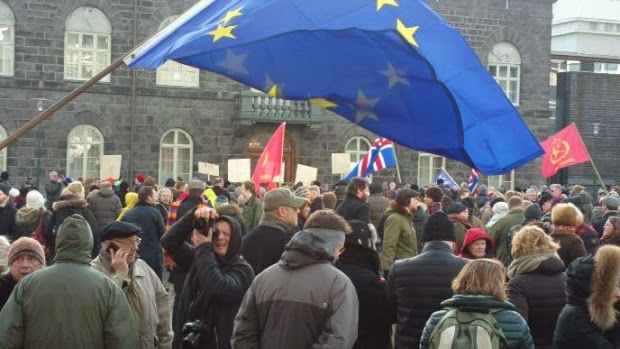
Icelanders Protest Government's Plans to Stop EU Talks

In Iceland, thousands of people have taken to the streets against the government’s move to end its bid to join the European Union without holding a referendum.

Despite an election campaign promise to put the question to the people, the two leading coalition partners decided not to take people’s views into account, leading some to ask for a rethink.


Around 4,000 people turned up to Austurvöllur square in front of parliament yesterday to protest the decision by the ruling Progressive and Independence Parties to put forward a resolution this week to withdraw from European Union talks.

Gudrun Rognvaldsdottir explained her reasons for coming out to protest:

“Because I want the accession talks to continue so we can vote on a finalised membership agreement. I think we should try to get as good an agreement as possible for the nation. And I believe we can reach such an agreement even though we are not represented by the most ideal people”.


A parliamentary debate on the contentious issue, originally proposed by the previous government, was postponed on Monday, but lawmakers will probably debate the bill on Tuesday February 25.


EU talks were put on hold indefinitely after the current government took power last year. The parliamentary debate on the resolution to withdraw from talks, scheduled for today, was moved to tomorrow, ruv.is reports. 

Source: Euronews
Iceland24h.blogspot.com, February 2014

Monday, February 24, 2014

Trip Report 4 days/3 nights in Iceland (February 2014)

I learned so much from this blog that I hope to pay it back a little. Hopefully this will be useful to those planning your first trip to Iceland.

Traveling in winter

We were very fortunate with the weather. It stayed dry and the winds weren't bad, so I can only speak to our experience. As long as you know how to layer properly, there are advantages to going to Iceland in the winter.


There are fewer tourists and winter has its own beauty, particularly in Iceland. I could see where the amount of daylight might be a problem closer to the solstice, but in the middle of February it wasn't an issue.

Car rental and driving

We rented from Reykjavík Cars because it was about $40 cheaper for a two-day. We were upgraded from a manual Jimny to an automatic Hyundai Tuscon. All of their vehicles include GPS, which I would highly recommend. Almost a must.

The people were great, pickup and dropoff were convenient, but you do get what you pay for. Thanks to the perfect weather, driving was easy. However, living in Colorado I recognized some places where driving could get really slippery with just a little bit of snow and typical Iceland winds.


I read it a lot here, but pay attention to the road conditions and don't push it -- especially if you're not used to winter driving. Also, be aware that gas is really expensive, especially compared to the States - almost $9/gallon. Keep that in mind when calculating the cost of renting a car and deciding which type of vehicle to rent.

Hotel

We had a package with Iceland Air and stayed all 3 nights at Center Hotel Skjalbreid. Great staff, clean, basic room, great location and solid value. Breakfast is included, which saved us a lot of money. There was some noise from late night folks enjoying multiple adult beverages, but nothing we couldn't tolerate.


I couldn't alter our accommodations because it was a package, but I wanted to spend one night in the Vik area. We could have seen Jökulsárlón and waking up one morning outside of the city would have been great, but the trip was still fantastic.

Food

We were so happy to be out exploring that food wasn't a high priority. Our one big "meal" was a dinner at Sakebarinn, which was OK. The salmon is fantastic, but the rest was mediocre. Just my opinion and it could have been an off night.

The Noodle Station was top notch. Great asian noodle soup - chicken or beef. We went to the world-famous hot dog stand twice. Not because it was cheap, but it was that good and interesting. So much different than american hot dogs.


The rest of the time we mostly went to grocery stores -- which are great places to see how people really eat in Iceland and probably everywhere -- and grabbed what looked interesting.

South Coast

Could I do this again, please? Like, once a week? Impossible beauty.

So many times I thought to myself, "This isn't real." It looked like somebody pulled down a fake backdrop screen around every turn. It's a must-do. We drove from Reykjavik to Vik and back, stopping at Seljalandsfoss, Skógafoss, the black beach in Vik and other places and small towns that looked interesting.


We saw the Black Beach from Vik, but missed the turn to the western side that's close to the basalt columns. The entrance isn't as obvious from the road, so make sure you find it on a map before you go. Or go on a tour. I saw busses at the stops and it didn't look like people were being rushed and herded like livestock. If that's more your style, go for it. The people all looked very happy.

Golden Circle

Again, how could that be real. So beautiful. If you're renting a car and doing a self-tour, my best advice is to research Þingvellir pretty thoroughly beforehand. I thought there would be visitor centers (there are) with detailed maps (there aren't). Maybe it's different in the summer, but I found the map provided at Þingvellir almost worthless. So do your homework about the park before you go or hook up with a tour. We still loved the park and got to walk the path between the two tectonic plates. You could spend many hours there, especially in the summer.


Geysir is not of this earth. Be very careful in the winter. There's lots of ice and I saw somebody slip and cut her head pretty badly. Or bring crampons. There's also a really nice store. It's not a long stop, but a really cool one. Gullfoss is the single most spectacular scene I've been lucky enough to see in my life. Seriously.

Reykjavik

It amazes me that a city of only 200,000 (including the suburbs) can have that dynamic of a downtown. It's not massive, but it's vibrant, clean and very safe while not feeling like you're in a fake Disney city. I was surprised at the amount of graffiti downtown - not street art, but tagging. It didn't bother me in the least, but it was unexpected. We took the last evening to drive all around the city and out in the suburbs.


We went to Kringlan to get the suburban feel of things, and I'm glad we did. After spending all trip focusing on how different things were, it was really interesting to see something so similar that was so far away from home. The names of almost all of the shops and restaurants are different, the language is different, but the scene was so familiar.

Friday night we went to Laugardalslaug and that was a great experience. It was open late as part of the Winter Lights Festival and they had a DJ. The taxi was about $18USD each way. On the way there I was working on my pronunciation of Laugardalslaug with the driver and he was laughing at me. We were all laughing.


I'm usually pretty good with picking up sounds from other languages, but Icelandic is brutal. There were lots of locals at the pool and it was great to see this part of their culture. The hotpots were really crowded and it was interesting to see such a different comfort level with little personal space.

I can't speak to the bar scene because it was a family trip. We did go into The Lebowski Bar because I love the film. That place had a great feel. There's no shortage of what look like excellent watering holes in Reykjavik.


It seems like much more of a cocktail/liquor scene as opposed to beer. There are a few pubs that are supposed to have a good selection of beer, but the places I saw mostly had two beers on tap. Also, I could see where partying in Reykjavik could raise the cost of your trip exponentially.

Northern Lights

We were lucky enough to see them on 2 of the 3 nights. The first night they were so strong that we could see them from downtown Reykjavik, which is very rare. The second night we went on a boat tour as part of the package. The lights were out early but didn't last long. By the way, if you're going to do a lights tour, I would suggest land rather than boat. I love being on the water, but a bus or jeep could take you much farther out and be more flexible with the destination.


I also want to reiterate what so many others say on this forum: Don't obsess about the Aurora. Yes, it's very cool and I'm so thankful that I had a chance to witness it, but you can't control the weather. It's out of your hands. If they don't come out for you, you'll still see so many spectacular things in Iceland that it won't really matter. I can honestly say that there were two or three other things that I saw on my trip that blew me away more than the Northern Lights.

Blue Lagoon

We went as part of the package and on the way to the airport. This is absolutely a matter of personal taste. If you like spas, you'll think you're in heaven. If that's not a big deal to you, feel free to leave Iceland without going to the Blue Lagoon. If it wasn't part of the package, I wouldn't have gone and would not have regretted it. Yes, the water and lava rocks are cool and soaking in the water before getting on the plane was nice, but it's a spa. Your opinion of it will depend upon how much you dig going to spas. That should cover it.


If you have any questions, please feel free to ask. Since I got so much out of this blog, I'll try to put some back in.

Iceland24h.blogspot.com, February 2014

Friday, February 14, 2014

Blue Lagoon (geothermal spa)

The Blue Lagoon (in Icelandic: Bláa lónið) geothermal spa is one of the most visited attractions in Iceland. The spa is located in a lava field in Grindavík on the Reykjanes Peninsula, southwestern Iceland.


Bláa lónið is situated approximately 13 km (8 miles) from the Keflavík International Airport and 39 km (24 miles) from the capital city of Reykjavík. That is roughly a 20 minute drive from the airport and a 40 minute drive from Reykjavík.


The warm waters are rich in minerals like silica and sulphur and bathing in the Blue Lagoon is reputed to help some people suffering from skin diseases such as psoriasis. The water temperature in the bathing and swimming area of the lagoon averages 37–39 °C (98–102 °F). The Blue Lagoon also operates a research and development facility to help find cures for other skin ailments using the mineral-rich water.


The lagoon is a man-made lagoon which is fed by the water output of the nearby geothermal power plant Svartsengi and is renewed every two days. Superheated water is vented from the ground near a lava flow and used to run turbines that generate electricity. After going through the turbines, the steam and hot water passes through a heat exchanger to provide heat for a municipal water heating system. Then the water is fed into the lagoon for recreational and medicinal users to bathe in.


We would recommend that you visit in the winter (no we are not crazy) for three reasons:

1. The first being that you wont enjoy a geothermal spa as much in hot weather
2. The second is that you cant see one of the most popular things to do in Iceland in the summer which are the Nothern Lights, and the last reason is that you will avoid the heard of tourists that arrive in the summer.  Who would want to sit in 100 degree water at the Blue Lagoon Iceland in the summer anyway?  It will get cold so make sure to bring a jacket along with your towel.


3. Once you step into the lagoon you will feel a slight slushy feeling on your feet which is the silica mud that many have found medical refuge in.  Its known to be an effective treatment for psoraisis and other skin ailments.


You can enter the water from outside the facilities or from inside so you dont have to step out into the cold weather in the winter. After entering the kids pool as I like to call it, the Blue Lagoon Iceland surprises you with a waterfall that you can sit by and enjoy (no time limits!).


We must have stood there for at least 15 minutes because it really felt like a water massage.  As you start to find your way around the lagoon there are certain canisters where you can scoop the silica mud and place it on your face.


In-water treatments

1. Relaxing Massage

Deep relaxing massage using a massage oil that contains Blue Lagoon active ingredients and essential oils. A unique experience for body and soul. 30 (60€) or 60 (90€) minute massage available, 15 min relaxation before and after is recommended.


2. Silica Massage for back

A deep cleansing and renewing massage that reduces stress and muscle tension in shoulders and back. The treatment is especially suitable for oily skin, prone to outbreaks. This massage leaves the skin with a healthy and glowing appearance (30 minutes, 70€).


3. Silica Massage for legs

A deep cleansing and renewing massage for legs. The treatment begins with a scrub for legs using Blue Lagoon silica mud, which cleanses and exfoliates. The treatment ends with a nourishing and relaxing massage using Blue Lagoon massage oil which encourages balance and wellness (30 minutes, 70€).


4. Beauty Treatments

All treatments are based on Blue Lagoon skin care products that contain the active Blue Lagoon elements: geothermal seawater, minerals, silica and algae. Select between facial treatments, manicure, pedicure and more (15 minutes, 12€).


5. Blue Lagoon Pregnancy massage

Relaxing and nourishing massage for expecting mothers. The massage is designed to relieve some of the normal discomforts during pregnancy, such as fatigue, backaches, and swollen feet (60 minutes, 95€).


6. Nourishing & Glowing algae treatment

A treatment that cleanses and nurtures the skin. It starts with a salt glow, where the skin is polished with a unique combination of Blue Lagoon minerals and oils, followed by a nourishing algae wrap, while face and scalp are gently massaged.

The treatment ends with a 50 minute full body massage in the lagoon. This extraordinary treatment leaves you energized and nourished (2 hours, 190€).


7. Energizing & firming silica treatment

A treatment that strengthens the skin. The skin is polished with minerals and oils, followed by a firming silica wrap, while face and scalp are gently massaged. Ends with a full body massage (2 hours, 190€).


Berglind, Iceland24h.blogspot.com
February 2014

Contact Form

Name

Email *

Message *